
DATA TALE · SOURCE-LINKED DATA
From scattered bond reports to verifiable ESG data
LuLarge brings bond reports, frameworks, impact disclosures and public sources together into a single source-linked data stream. Data curation becomes more reliable: values, units, sources and review logic stay traceable together.
§01 · SITUATION
The starting point
In the market for green, social, sustainability and sustainability-linked bonds, the relevant information is scattered across many sources: impact reports, green bond frameworks, second party opinions, issuer websites, tables, PDF documents and databases.
For ESG data providers, rating agencies, asset managers and market infrastructures, this creates an operational bottleneck. The data exists, but it is inconsistently structured, often not machine-readable, and hard to trace back to its source.
In this environment, players such as EF Data, LGX DataHub, Bloomberg, LSEG, S&P Global, RepRisk, Clarity AI, SESAMm, GRESB or Climate Aligned work on providing, assessing and curating sustainability-related financial data.
The real bottleneck does not lie only in the analysis. It comes earlier: in reliably turning scattered documents into robust, traceable and reusable data points.
§02 · WHAT WE BUILT
A solution for source-linked ESG data curation
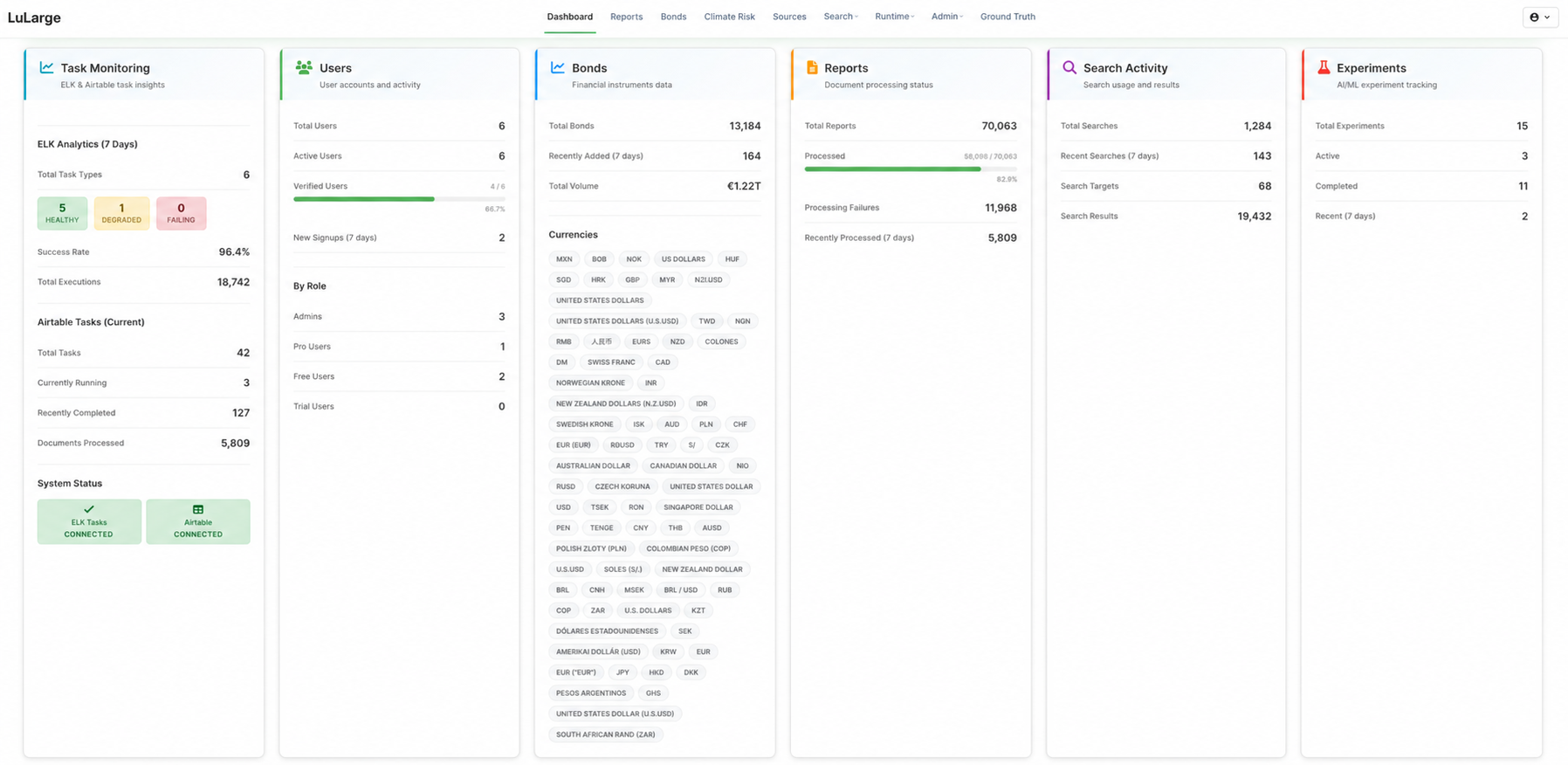
LuLarge processes heterogeneous bond and sustainability documents into structured data products. The solution combines data collection, document processing, classification, extraction, normalisation and validation in one end-to-end data workflow.
From an impact report, this produces more than an isolated number. An extracted data point is linked to its source, context, unit, data field, review logic and machine-readable output.
The application makes this process visible: users can trace where information comes from, which fields were extracted, which data is ready for further use, and where additional review makes sense.
The focus is on reliable data curation. Data is not just collected, but prepared so it can be reused in ratings, reporting, data services, due-diligence processes and APIs.
- Aggregation of bond reports, frameworks, impact disclosures, websites, tables and further ESG-relevant sources
- Extraction of metadata, allocation data, emissions values, project information and impact metrics
- Normalisation of dates, currencies, units, measures and reporting structures
- Source linking across documents, pages, sections and structured references
- Validation through pattern checks, semantic grounding, confidence scores and LLM-assisted review logic
This makes data curation more reliable: it is not only the data point that counts, but also its origin, its context and its verifiability.
§03 · BUSINESS VALUE
Business value
For data providers and financial market players, this creates a more robust preparation layer ahead of analysis, rating, reporting and product development.
Manual document work is reduced while the traceability of individual data points increases. Analysts and reviewers no longer have to search for information again every time, but can draw on structured, source-linked data.
This makes it possible to improve existing data products and to build new product lines, for example for on-demand impact report analyses, structured bond data services or API-ready ESG data streams.
- Faster processing of large and heterogeneous document collections
- More reliable data curation through source, context and unit binding
- Better handover to ratings, reporting, due diligence, data platforms and APIs
- Less dependence on purely manual review and copy-paste processes
- A stronger basis for new data-driven services in sustainable finance
§04 · WHY IT MATTERS
Why it matters
Many organisations invest in dashboards, analyses or AI assistants even though the underlying data base is not yet robust enough. The real value creation begins where scattered information becomes verifiable, structured and reusable.
In sustainable finance, this preparation is particularly important. Greenwashing risks, regulatory requirements and rising reporting obligations increase the pressure on data quality, proof of origin and traceability.
AI does not create value here by replacing expert decisions. It creates value when it structures data curation, source work and review processes so that people can verify, decide and continue working faster and with more confidence.
A trustworthy data stream thus becomes an operational foundation: it connects documents, data points, sources, review rules and human oversight.
§05 · TRANSFERABLE RELEVANCE
Transferable relevance
What transfers is not only the ESG bond context, but the pattern behind it: critical business areas need data that is not just extracted, but made verifiable.
The same challenge arises wherever decisions rest on PDFs, tables, databases, websites, portals and internal files while traceability, quality and governance matter at the same time.
- ESG data spaces from reports, tables, portals and internal files
- Compliance evidence collections with source references and an audit trail
- Funding, procurement and project documentation with a structured evidence base
- Financial, risk or sustainability data from inconsistent document collections
- AI-assisted preparation layers for expert processes in regulated business areas
The transferable pattern is: first build a reliable curation layer — then build analysis, reporting, automation and AI on top of it.
§06 · EVIDENCE
WHAT WE CAN EVIDENCE
- LuLarge processes ESG and impact data along a workflow of data collection, classification, extraction, normalisation and validation.
- The solution addresses data points such as metadata, allocation data, GHG values, project information and impact metrics.
- The validation logic combines classical checks with AI-assisted source and plausibility verification.
- Its market scope covers ESG data providers, rating agencies, financial data vendors and sustainable finance market infrastructures.
WHERE THE CLAIM ENDS
This example shows a traceable curation and validation logic for ESG bond data. It does not replace expert ESG assessment, a rating, or a regulatory classification — it prepares data points so they can be verified, but it does not make the underlying sustainability judgement.
KEY TAKEAWAY
Anyone who wants to support critical decisions with AI and data first needs a reliable curation layer: data points must not only be found, but made verifiable.
Want to know more?
Book ConsultationReady to price physical risk accurately?
Get defensible, asset-level evidence that survives due diligence. Book a consultation.
No generic ratings. Asset-level precision. Audit-ready evidence chains.